Auspex vs Profound & 9 Other AI Visibility Tools: Which One Is Built for Brands That Sell Products?
Compare Auspex vs Profound and 9 AI visibility tools (AEO/GEO). See which is built for brands that sell products on Amazon and marketplaces.
Shoppers no longer scroll ten blue links. They ask ChatGPT, Perplexity and Gemini “what should I buy?” and act on the single answer that comes back. That shift created an entire new category of software: AI visibility tools, also called Answer Engine Optimization (AEO) or Generative Engine Optimization (GEO). Dozens launched in the last 18 months. This post compares the ten best-known, led by Profound, against Auspex, and explains why almost all of them are built for enterprise marketing teams tracking a brand name, not for the brands that actually sell products and need AI to recommend what they sell.
What these tools all do (and where they differ)
Every tool in this category does some version of three things: run a library of buyer questions across AI engines, measure whether a brand is recommended, and track it over time against competitors. The differences come down to four questions that matter enormously if you sell products:
- Which AI engines do they track, and how frequently?
- Do they only measure, or do they also fix, draft the content and optimize the listings and pages that change the answer?
- Are they oriented around brand-reputation monitoring, or around the purchase-intent buyer questions that decide which products actually get bought?
- Who is it built for, enterprise web marketers, or brands selling products on marketplaces and DTC, and can you start self-serve, or does it need a sales call?
The ten tools at a glance
| Tool | Engines tracked | Fixes it for you? | Built for | Entry |
|---|---|---|---|---|
| Auspex | ChatGPT, Perplexity, Gemini | Yes, agents run it | Ecommerce & marketplace brands | Free check · self-serve |
| Profound | ChatGPT, Perplexity, Gemini, Copilot | Guidance, not execution | Enterprise web brands | ~$99–399/mo |
| Scrunch | Multi-LLM (broad) | Yes, optimize | Full-stack GEO teams | Paid |
| Otterly.ai | Major engines | Monitor only | Simple monitoring | ~$25/mo |
| Peec AI | Major engines | Monitor only | Lean marketing teams | Paid |
| AthenaHQ | Major engines | Some | Mid-market / enterprise | Paid |
| Semrush | ChatGPT, Gemini, AI Overviews | SEO tips | Existing Semrush users | Free 3/day · $99/mo |
| Ahrefs | ChatGPT, Gemini, Perplexity, +AI | SEO-first | SEO teams | Free · $50+/mo |
| HubSpot | ChatGPT, Gemini, Perplexity | No (grader only) | Brand / reputation lens | Free · $50/mo |
| Rankscale | Major engines | Monitor only | Budget monitoring | ~$20/mo |
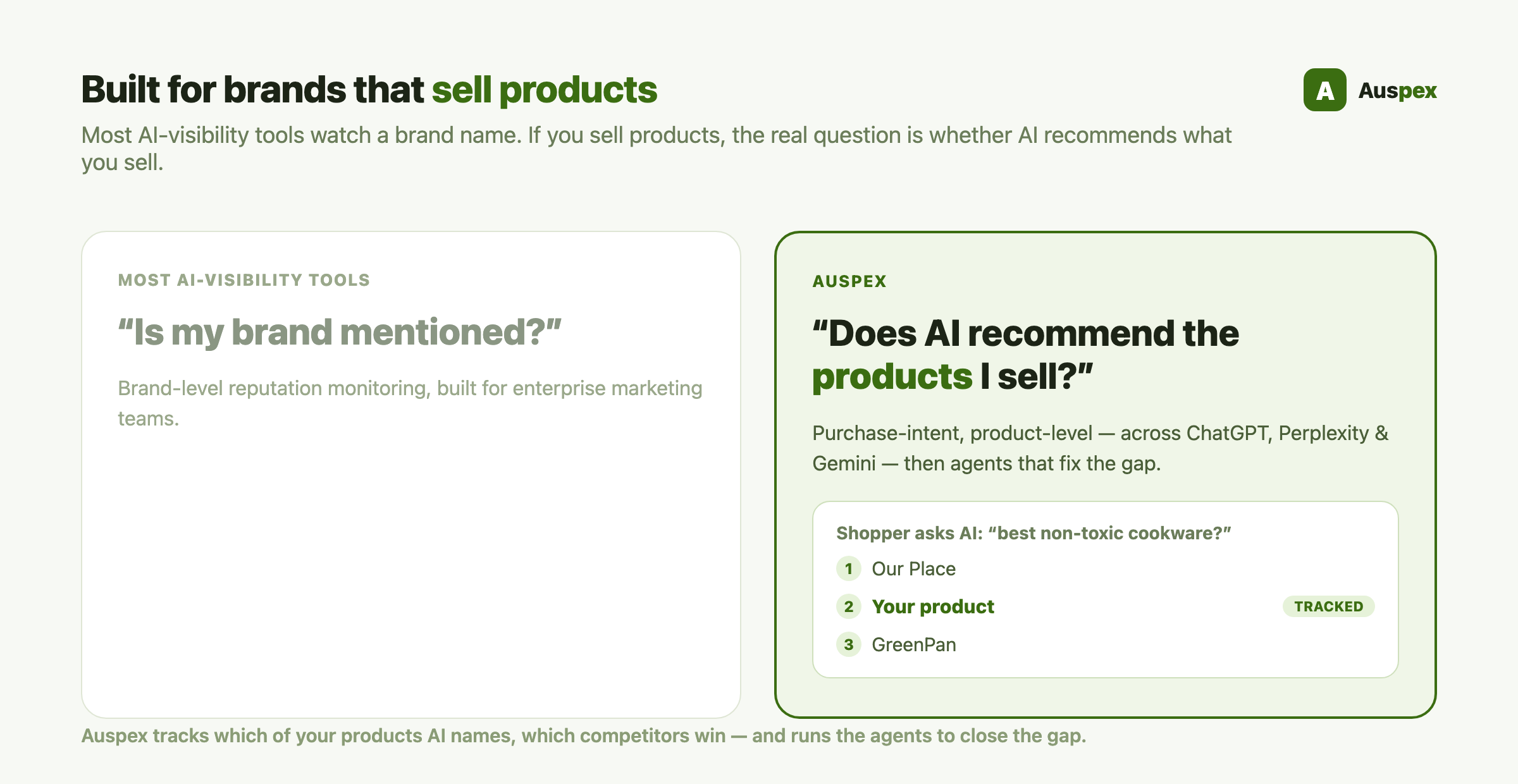
The pattern is hard to miss. Almost every tool is built for an enterprise marketing team watching a brand name on the open web, and almost every tool stops at measurement, it hands you a score and leaves the actual work to you. For a brand that sells products, two things matter more: whether AI recommends the products you sell for real purchase-intent questions, and whether anyone will do something about it. That orientation, purchase-intent product visibility, plus agents that run the fixes, is what Auspex is built around.
Tool by tool, the honest version
Profound is the category leader and deservedly so. Its strength is depth of data: AI results tracking, a Conversation Explorer built on hundreds of millions of real user prompts, and AI-crawler analytics. It serves enterprise marketing teams (a chunk of the Fortune 500) and is priced for them, a Starter plan around $99/mo that tracks only ChatGPT, jumping to roughly $399/mo for real coverage. It is a phenomenal tool for a large web brand. It is not designed for a product-selling marketplace or DTC brand, and it stops at guidance rather than running the fixes for you.
Scrunch is arguably the most complete open-web GEO platform, multi-LLM monitoring plus auditing, optimization and AI content delivery in one stack, with strong reviews. Otterly.ai does automated monitoring well and affordably: build a prompt library, run it on a schedule, get alerted. Peec AI takes the opposite bet, a deliberately minimal dashboard of three numbers (Visibility, Position, Sentiment) for lean marketing teams. AthenaHQ is a polished, highly rated mid-market/enterprise option with recognizable logos.
Then there are the SEO incumbents bolting AEO on: Semrush’s AI Visibility Toolkit and Ahrefs’ Brand Radar both add AI-answer tracking to a mature SEO suite, great if you already live there, but AEO is an add-on, not the core. HubSpot’s AI Search Grader frames visibility through a brand/reputation and sentiment lens (and is a useful free snapshot). Rankscale and similar entrants compete on price for basic monitoring. Every one of them is built for the open web.
Where they leave product brands wanting
If you sell products on Amazon, Walmart or your own store, three gaps show up across the entire field:
- They measure, they do not fix. Most tools hand you a dashboard and leave the work, the FAQ content, the listing copy, the citations, the review proof, to you. Visibility without the fix is a thermometer, not a cure.
- Built for brand marketers, not product sellers. The workflows, vocabulary and integrations assume a content/SEO team watching a brand name on a website, not a brand owner who needs AI to recommend the specific products they sell, and to optimize the catalog and product Q&A behind them.
- Enterprise pricing and onboarding. Sales-led demos and $400+/mo plans fit a Fortune 500 marketing budget, not a growing seller who wants an answer this afternoon.
How Auspex is different
Auspex is the AI-visibility platform built for brands that sell products. The differences are deliberate:
- Purchase-intent, product-level visibility. Auspex is built around the buyer questions that actually drive sales, “best non-toxic cookware?”, “safest baby blanket?”, measuring whether AI recommends the products you sell, and which competitors win, across ChatGPT, Perplexity and Gemini.
- Fixes, not just measures. Auspex runs agents that close the gaps: draft the FAQ and answer content engines pull from, optimize your product listings and Q&A for how AI reads them, find high-authority sources to get cited on, and turn your best reviews into citeable proof, with your approval on anything that touches a live listing.
- Built for ecommerce, marketplace and DTC brands, the ICP, not an afterthought. The scoring, prompts and workflows speak your language: category buyer questions, competitor share-of-voice, listing optimization.
- Self-serve and instant. Run a free AI-visibility check on any brand in about ten seconds, no signup, no sales call, and see exactly which buyer questions recommend you versus your competitors before you commit to anything.
Auspex vs Profound, specifically
Because Profound is the benchmark, it is worth being precise. If you are an enterprise brand whose visibility battle is brand-level and on the open web, ChatGPT, Perplexity, Google’s AI Overviews, Profound is an excellent, deep, well-funded choice, and its Conversation Explorer data is genuinely unique. Auspex is not trying to out-enterprise Profound. Auspex wins when you sell products: it is oriented around purchase-intent, product-level buyer questions rather than brand monitoring, it executes the fixes rather than only reporting, and it is self-serve and affordable for a seller rather than sales-led and enterprise-priced. Different buyer, different battlefield.
Which should you choose?
- Enterprise web brand, big marketing team, open-web focus Profound or Scrunch.
- You already live in Semrush or Ahrefs and want a light AI add-on their AEO toolkits.
- You want a simple, cheap monitor of a few prompts Otterly, Peec or Rankscale.
- You sell products on marketplaces (Amazon/Walmart) and/or DTC and want to both see and fix how AI recommends the products you sell, self-serve and affordable Auspex.
The bottom line
The AI-visibility category is crowded, but it is crowded with tools built to watch a brand name for enterprise marketing teams. If you sell products, the questions that matter are narrower and sharper: does AI recommend the products I sell when shoppers ask what to buy, and who is going to fix it when it does not? Auspex is built for exactly that, measuring how ChatGPT, Perplexity and Gemini recommend your products for real purchase-intent questions, and running the agents that win the answer. As in-marketplace assistants like Amazon’s Rufus and Walmart’s Sparky mature, tracking them is on our roadmap. Run a free instant check and see where you stand in the AI answers your shoppers are reading right now.
FAQ
For brands that sell products on Amazon, Walmart, or DTC, Auspex is built specifically for purchase-intent product visibility, and it runs agents that fix the gaps rather than only reporting them. Profound remains a strong choice for enterprise web brands doing brand-level monitoring.
Most tools in the category stop at measurement, dashboards and scores. Auspex and Scrunch are the exceptions that execute: Auspex runs agents that draft content, optimize listings, and earn citations, with your approval on anything that touches a live listing.
Budget monitors like Otterly and Rankscale start around $20–25/mo. Enterprise platforms like Profound run roughly $99–399/mo and are typically sales-led. Auspex is self-serve, and you can start with a free instant visibility check, no signup or sales call.
Run a free instant check. No signup required.